
Bite Collapse and Jaw Problems: Causes, Symptoms & Treatment
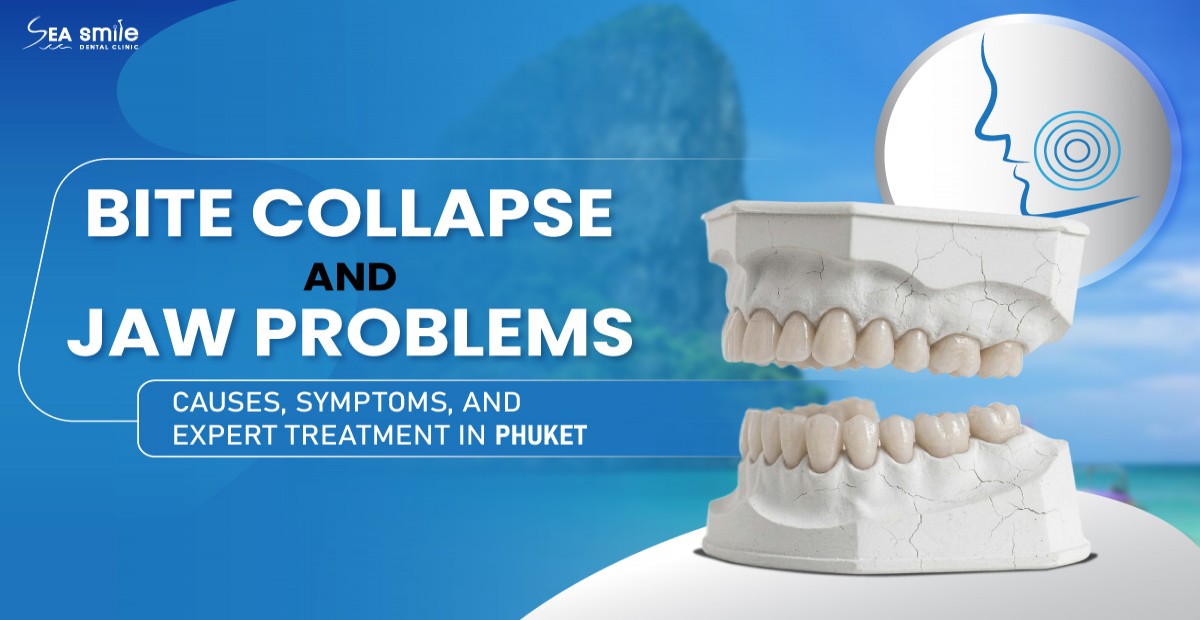
When most patients experience a dental issue, they naturally assume the problem is entirely isolated to one specific tooth. A chipped edge, a minor cavity, or a single missing tooth is often viewed as a localized inconvenience. However, the biological reality is vastly different: your mouth functions as a highly complex, interconnected system. When the structural balance of that system is compromised—whether due to severe tooth wear, untreated missing teeth, or a long term bite imbalance—the entire oral foundation can begin to fail.
This devastating chain reaction is clinically referred to as bite collapse (or occlusal collapse). Bite collapse is not merely a cosmetic issue involving worn-down teeth; it is a severe functional disorder that deeply affects your jaw joints, your chewing muscles, your daily comfort, and even your overall facial proportions. At Sea Smile Dental Clinic in the stunning tropical destination of Phuket, our dental specialists routinely treat international patients suffering from the debilitating effects of bite collapse. This comprehensive guide will explain exactly how your bite loses its balance, the hidden symptoms you must watch out for, and the world-class reconstructive treatments we utilize to restore your oral health and facial harmony.
What Exactly Is Bite Collapse? The Domino Effect
To understand bite collapse, you must first understand how a healthy mouth is designed to function. A proper, healthy bite is mathematically designed to distribute the immense mechanical forces of chewing evenly across multiple teeth. Your upper and lower teeth should meet in perfect harmony, supporting your jaw in a stable resting position. Bite collapse occurs when this natural, delicate balance is permanently lost. When the structural height of your teeth is reduced, it directly results in a loss of your vertical dimension (the physical, anatomical height between your upper and lower jaws when your mouth is closed). As this dimension shrinks, highly uneven chewing forces begin to overload isolated, vulnerable teeth. Your jaw muscles are forced to overcompensate for the new, awkward alignment, leading to intense muscle strain and severe stress on your temporomandibular joints (TMJ). What begins as a single missing tooth or a slight grinding habit slowly evolves into a total systemic failure.
The Hidden Causes: How Does a Bite Collapse?
Bite collapse rarely happens overnight. It is usually a very gradual, insidious process that develops over years or even decades. The most common structural causes evaluated at Sea Smile Dental Clinic include:
1. Long-Term Missing Teeth
This is the absolute most common catalyst for bite collapse. When you lose a tooth and fail to replace it with a dental implant, the surrounding teeth do not simply stay in place. The adjacent natural teeth will begin to gradually tilt and drift into the empty space. Simultaneously, the opposing tooth on the opposite jaw will "over-erupt" (grow downward or upward) because it no longer has a chewing partner to stop it. Over years, this massive shifting completely destroys the balance of your bite.
2. Severe Tooth Wear (Bruxism)
Chronic teeth grinding and clenching (bruxism) places catastrophic mechanical stress on your dental enamel. Over time, this relentless friction heavily flattens the chewing surfaces of your teeth and drastically shortens your front teeth. As the teeth become physically shorter, your vertical dimension naturally collapses along with them.
3. Uneven Chewing Habits
If you have an untreated cavity or a painful tooth on one side of your mouth, you will naturally begin to chew exclusively on the opposite side to avoid the pain. Over years, this chronic, one-sided chewing forces half of your mouth to absorb 100% of your bite force, leading to rapid, highly localized wear and severe structural shifting.
The Warning Signs: Symptoms You Should Never Ignore
Because bite collapse is a slow-moving condition, the symptoms are incredibly easy to ignore in the early stages. However, as the system destabilizes, your body will send clear warning signals. You should seek an immediate evaluation at Sea Smile Dental Clinic in Phuket if you experience any combination of the following:
Dental and Functional Symptoms:
- Shortened Front Teeth: Your front teeth appear visibly smaller, flatter, or frequently chip at the edges.
- Chewing Difficulty: You experience a highly inefficient chewing process or a sensation that your teeth simply "don't meet properly" anymore.
- Repeated Dental Failures: You suffer from frequent crown fractures, cracked porcelain, or fillings that constantly fall out due to unbalanced forces.
- Tooth Mobility: Your remaining natural teeth begin to feel slightly loose or are actively shifting positions.
TMJ and Muscular Symptoms: When your bite balance changes, your jaw joint position shifts unnaturally. Your facial muscles must work overtime to compensate, leading to chronic inflammation. This manifests as:
- Loud clicking, popping, or grating sounds in your jaw joints (TMJ).
- Severe muscle fatigue in your face and jaw after eating.
- Chronic tension headaches (frequently misdiagnosed as traditional migraines).
- Pain or locking when opening your mouth widely.
Facial Aging and Aesthetic Changes: Bite collapse dramatically ages your face. As you lose vertical dimension, your lower face physically shortens. This lack of internal structural support leads to thinner-looking lips, the formation of deep, premature wrinkles around the corners of your mouth, and a generally "sunken" facial appearance.
How the Experts Diagnose Bite Collapse in Phuket
Properly treating a collapsed bite requires immense clinical expertise. At Sea Smile Dental Clinic, we do not simply look at the appearance of your teeth; we meticulously evaluate how your entire oral system distributes force. Our world-class diagnostic protocol includes advanced full-mouth digital X-rays and 3D CBCT imaging to assess your underlying bone and joint health. We perform rigorous digital bite analysis, capture detailed photographic documentation, carefully measure your lost vertical dimension, and conduct a thorough TMJ muscle palpation exam. This systemic diagnosis is the only way to formulate a treatment plan that guarantees long-term success.
Comprehensive Treatment Solutions at Sea Smile Dental Clinic
Because bite collapse affects multiple aspects of your oral health, treatment requires a highly customized, multi-phased approach. Depending on the severity of your specific case, our elite specialists in Phuket may recommend one or more of the following restorative protocols:
- Minor Occlusal Adjustment (Equilibration) In very mild cases of early bite imbalance, our specialists can perform selective, microscopic reshaping of your dental enamel. By gently adjusting the precise points where your teeth contact each other, we can instantly improve force distribution and relieve minor muscle tension. This is a highly conservative approach limited to very early-stage discrepancies.
- Restoring Vertical Dimension (The Phased Approach) In cases of moderate to severe wear, the lost vertical height of your face must be carefully increased. We do not do this overnight. We utilize a highly structured phased approach, placing advanced temporary restorations based on a digital diagnostic wax-up. This "bite testing phase" allows your jaw muscles and TMJ to safely and comfortably adapt to the newly restored vertical dimension before any permanent ceramic crowns are fabricated.
- Comprehensive Full-Mouth Rehabilitation In advanced cases of total bite collapse, a full-mouth reconstruction is strictly required. This life-changing treatment involves placing highly durable digital crowns or porcelain veneers on multiple teeth to rebuild your structural balance. By restoring every tooth in harmony, we eliminate destructive chewing forces and recreate a flawless, perfectly balanced smile. Because this treatment restores your facial height, many patients experience a remarkable "non-surgical facelift" effect.
- Implant-Supported Reconstruction. When bite collapse is driven by multiple missing teeth and compromised jawbone support, dental implants are the ultimate gold standard for restoration. By placing strategic titanium implants, we replace the missing roots, halt further bone loss, and provide an incredibly strong foundation for new crowns or full-arch bridges. These implants are positioned using advanced 3D guided surgery to ensure they perfectly align with your newly corrected bite.
The Crucial Role of Long-Term Maintenance
Rebuilding a collapsed bite is a massive clinical achievement, but ensuring that your new smile lasts for decades requires an ongoing partnership. After your bite reconstruction is completed at Sea Smile Dental Clinic, long-term stability depends heavily on your post-operative maintenance. If you have a history of bruxism, wearing a custom-fitted night guard is absolutely mandatory to protect your new ceramics from subconscious grinding forces. Furthermore, you must maintain impeccable daily oral hygiene and attend periodic bite reviews with your local dentist to ensure your forces remain perfectly balanced over the years.
Rebuild Your Bite and Reclaim Your Life in Phuket
Living with bite collapse means living with chronic discomfort, compromised chewing function, and severe premature facial aging. But you do not have to accept this as your permanent reality. By choosing to travel to Sea Smile Dental Clinic in Phuket, you gain access to world-class diagnostic technology, elite restorative specialists, and highly affordable comprehensive care—all set against the backdrop of one of the world’s most beautiful tropical islands. Instead of recovering in a stressful, cold city, you can spend your healing days relaxing by the Andaman Sea, enjoying soft, delicious Thai cuisine, and experiencing unparalleled hospitality.
Stop letting a collapsing bite dictate your quality of life. Contact our expert international coordination team today. Send us your diagnostic X-rays, and let us design a comprehensive, failure-proof rehabilitation plan that beautifully restores your smile, your comfort, and your total systemic health. Click to Book Now.